Nov 13, 2026 · @Sonnymilesmd
The Hope for a Simple Answer
"I'm just so tired." I hear those words from women more than almost anything else. I feel them in my bones, because I have lived there, and in some seasons I still do.
When women come to my practice hoping to feel less tired, they are usually hoping the answer will be simple: anemia, a sluggish thyroid, a hormone that needs adjusting. They want something a lab can find and a supplement can fix. I understand that wish completely. When you are exhausted, you don't have the energy to overhaul your life, so of course you want the fix to be small.
Sometimes it is. More often, though, fatigue grows from several things at once. Part of it is how we care for our physical bodies. Part of it is what I call misalignments: the moments when your body tells you something and you override it because you think you should be doing something else (full disclosure, I borrowed the word misalignments from Dr. Amanda Hanson). Fatigue is rarely one broken part waiting to be repaired. More often, it is information.
First, What Kind of Tired?
"Tired" covers very different experiences, and each one points in a different direction. So the first thing I ask is what you actually mean:
Sleepy tired: you could nod off at your desk, in a meeting, or behind the wheel.
Weary tired: everything feels hard, and both your body and your heart feel heavy.
Afternoon-crash tired: you feel good in the morning but are depleted by mid-afternoon.
Then I ask a second question that often reveals more than the first: when did you last feel truly energized and well? What changed in your life around that time is often where the story begins.
Start With the Body
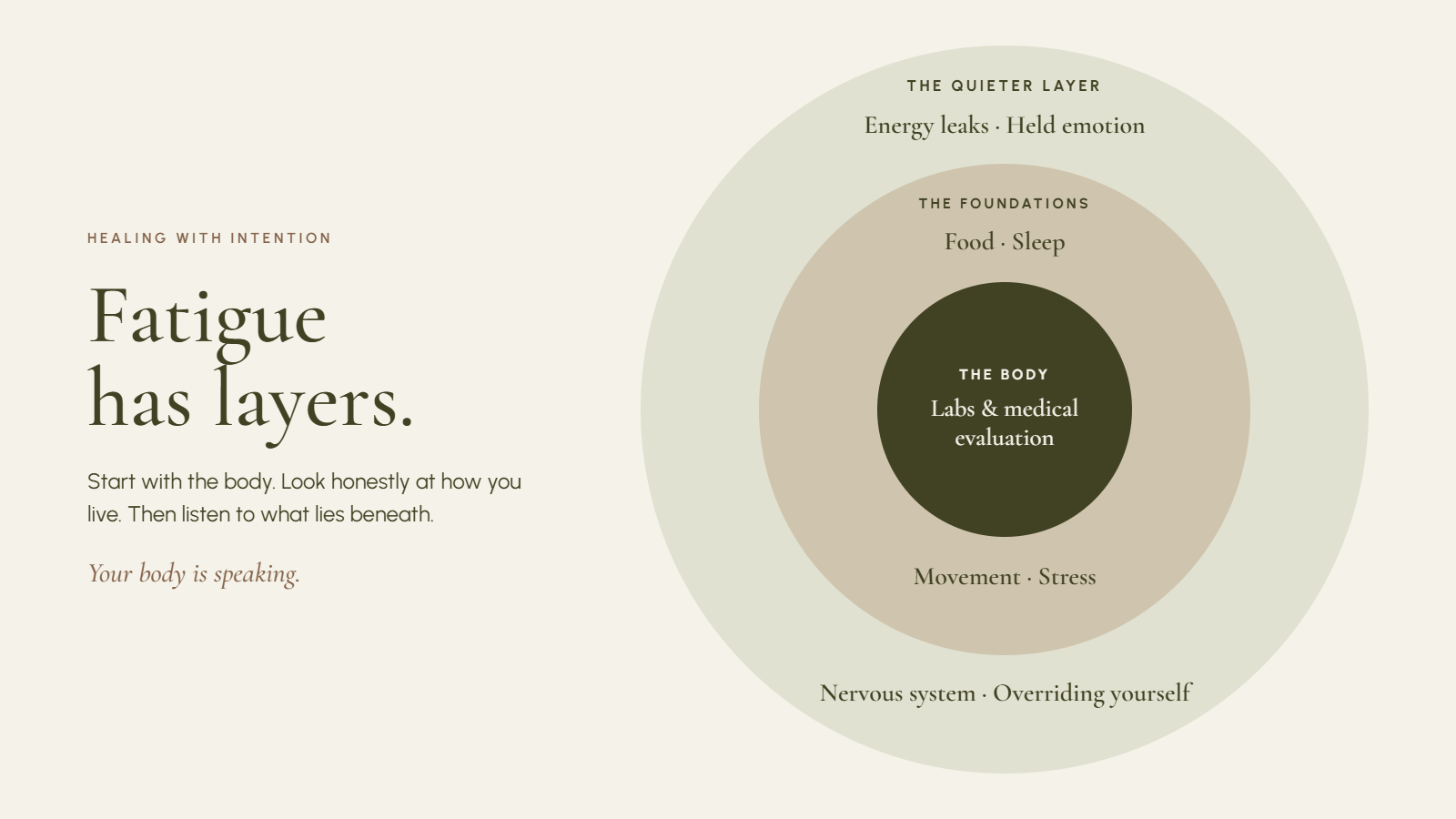
Fatigue can signal something that needs medical attention, so a careful evaluation always comes first. When I look for physical contributors, I consider:
Hormones: thyroid function, the HPA axis (the stress-response conversation between your brain and adrenal glands), and the shifts of perimenopause.
Nutrition and nutrients: what you are eating, whether your body is absorbing it, and whether deficiencies have quietly developed.
Inflammation and toxic exposures.
Daily habits: sleep, movement, stress, and food.
My initial lab evaluation usually includes a complete blood count, a comprehensive metabolic panel, hemoglobin A1c, a thyroid panel, and ferritin. Depending on the person, I often add vitamin B12, homocysteine, high-sensitivity CRP (a marker of inflammation), and vitamin D. More specialized testing follows from each woman's story and symptoms.
Here is the part that surprises many people: normal labs are reassuring, but they are not the end of the conversation. A normal result tells us what is probably not wrong. It rarely explains why you wake up every morning feeling like you never slept.
The Foundations: Food, Sleep, Movement, and Stress
This is where the work becomes more challenging, and often more meaningful, because it is about your life. Many of us are not living in ways that truly meet our needs, and fatigue is one of the most common ways that gap shows up. I begin with four foundations.
Food
I want to know not only what you eat but how. How much protein and fiber are in your meals? Do you favor cold foods or warm ones? Do you eat at fairly consistent times, or graze through the day? Do you sit down for a meal, or eat while scrolling, reading, or working? That last habit matters more than most people realize, because digestion works best when your body is at rest.
The next layer is how your body receives the food. How do you feel after you eat? How regular are your bowel movements? Nourishment depends on absorption, not just intake.
Sleep
I ask when you go to bed, how many hours you sleep, and whether you fall asleep easily. What does your wind-down routine look like? Do you wake feeling refreshed? Do you get morning sunlight? Are you drinking caffeine in the afternoon or alcohol in the evening?
I also look for hints of sleep apnea. It is often missed in women, partly because it doesn't always look like the classic picture of loud snoring.
Movement
Fatigue can come from too little movement and from too much. Some women sit at a computer all day and squeeze in an intense workout at night. Others push so hard that they feel wiped out afterward instead of energized. I want to know what kind of movement you do, how often, whether you take movement breaks during the day, and how your body feels both during and after.
Stress
Stress touches everything. It shapes what you reach for to eat, how deeply you sleep, and how your nervous system functions. I ask women to rate their stress from 0 to 10, where 10 is the worst stress of their life. Then I ask how they manage it, and where they feel it in their body.
You don't have to change your whole life to begin feeling better. Small, consistent changes in these four areas can go a long way.
The Quieter Layer: Where Your Energy Actually Goes
This is the part of fatigue that rarely makes it into a fifteen-minute appointment, and in my experience it is often the heart of the matter. Most of these contributors are misalignments, and none of them show up on a lab report.
Energy leaks
How much of your day is spent doing things that fill you up, and how much is spent on tasks that drain you? Are you in environments that feel good, or ones that take extra effort just to navigate? Are you surrounded by people who support you, or people you feel you need to protect yourself from? Protecting yourself takes energy, even when you don't notice you are doing it.
Some leaks are internal. When I am angry, my mind can replay an imaginary argument on a loop. It never resolves anything, and it leaves me depleted. Where are the leaks in your life?
Unprocessed emotion
How much grief or anger are you carrying? Holding emotion down takes effort, and that effort has a cost. Do you have ways to express grief and rage, or do you tend to swallow them? And on the other side: do you feel joy? Is there enough laughter and play in your life?
Your nervous system
Are you in relationship with your body and your nervous system? Do you notice when you start to become dysregulated? Do you recognize the moment you become so overwhelmed that you want to freeze, collapse, and disappear into your phone or the television? Being stuck in fight-or-flight can contribute to sleep that doesn't restore you, which is why some women sleep eight hours and still wake up exhausted. Having tools to help your body find its way back to calm is not a luxury. It is part of treatment.
Overriding yourself
Finally, do you honor your body's needs, or do you routinely override them? You keep working when you are exhausted because something has to get done. You say yes when every fiber of your being is saying no. Someone mistreats you, and you swallow your voice instead of setting a boundary. You return to a job or relationship you know is unhealthy because you feel you have no choice.
Each of these moments asks your body to absorb a cost on your behalf. Over years, that adds up. Being at war with your own body is exhausting.
Listening to What Your Fatigue Is Telling You
Fatigue has many roots, and many of them are within your power to change, step by step and day by day.
I would be remiss not to say this clearly: fatigue can sometimes be a symptom of serious illness, including cancer and autoimmune disease. An appropriate medical evaluation is always essential. But for most women, the evaluation alone is not enough. Feeling better usually means making changes that honor what your body has been trying to say.
If you are not sure where to start, choose one question from this article that made you pause. That pause is worth paying attention to. Your body is speaking.
If you live in Colorado and would like a thorough, whole-person evaluation of your fatigue, I invite you to schedule a free discovery call with Dr. Sonny Miles. And remember: This information is being provided to you for educational and informational purposes only. It is being shared to provide general information and as a self-help tool for your own use. It is not to be substituted for the advice of licensed professionals of any kind. This information is to be used at your own risk based on your own judgment. For my full Disclaimer, please go to https://www.healingwithintentionim.com/disclaimer